Three people asked me why I wanted to spend the summer in Granada.
I gave them different answers because I wasn’t entirely sure myself. I knew Granada had flamenco. Everybody knows that. What I wanted to understand was why flamenco from Granada feels so different from what you hear in Sevilla or Jerez.
The simple answer is Sacromonte.
The fuller answer involves caves, Gitano families, Moorish influence, wedding dances and a city that has never quite separated its music from its history.
Granada’s flamenco can be rough and intimate. At other times it sounds almost weightless. The voice stretches out while the guitar waits underneath it. Then the rhythm returns and suddenly there is nowhere to hide.
That is what brought me here.
Flamenco changes when the city changes
People talk about Andalusian flamenco as though it were one tradition with a few local accents. Spend time listening to it and that idea quickly falls apart.
Jerez has a weight to it. Compás feels built into the place. Sevilla is broader and more theatrical, with peñas, tablaos, schools and performers arriving from everywhere. Cádiz often carries a lighter surface even when the words underneath are doing something else entirely.
Granada does not behave like any of them.
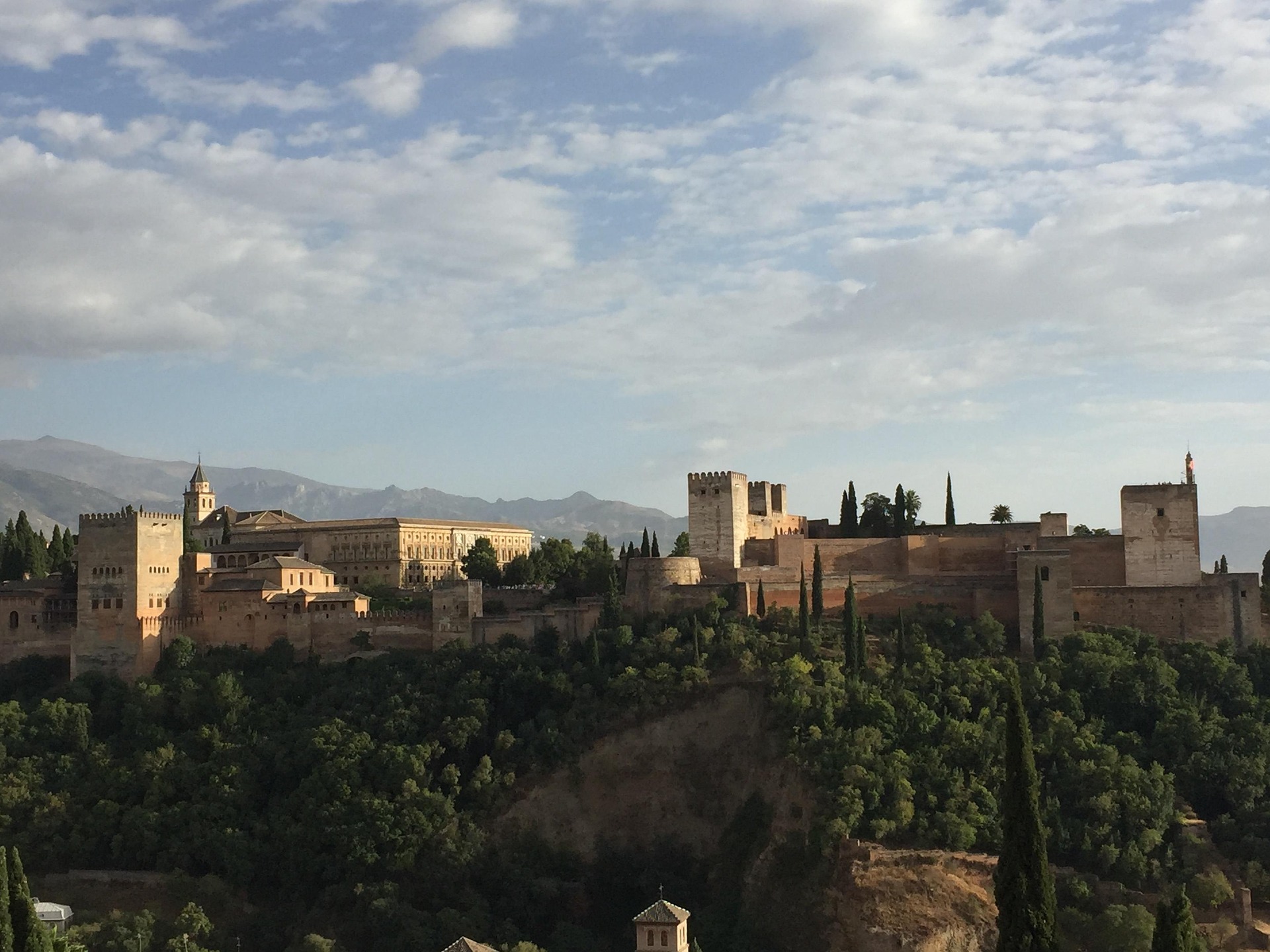
Part of that comes from geography. The city sits inland beneath the Sierra Nevada rather than opening towards the Atlantic. Its best-known flamenco neighbourhood rises above Granada itself, cut into a hillside and facing the Alhambra.
Sacromonte is physically close to the rest of the city. It has also spent much of its history being treated as somewhere apart.
That distance matters.
Sacromonte and the zambra
Sacromonte became home to Granada’s Gitano community from the late 15th century onwards. Families lived in cave houses dug into the hillside and developed a flamenco tradition tied closely to the place.
The form most associated with Sacromonte is the zambra.
Today the word is often used for the flamenco performances held inside the caves. Historically the zambra gitana was connected with Gitano wedding celebrations. Its different dances represented stages of the wedding and were performed at close quarters rather than on a conventional theatre stage.
That changes the relationship between the dancer and everyone watching.
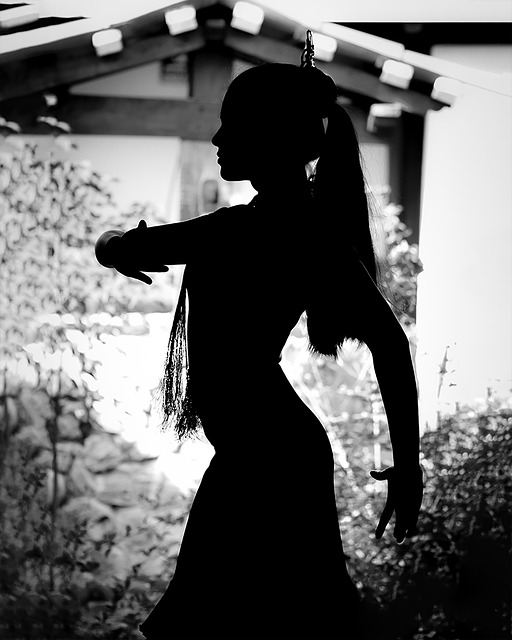
There is no comfortable distance. In a cave the audience sits around the performers. The sound strikes the walls and comes back. A turn that might disappear on a large stage suddenly feels enormous. Footwork does not need amplification when it is happening a few feet away.
Some cave performances are now organised firmly around tourism. That does not make the zambra itself a tourist invention. The tradition existed long before Granada appeared in package-holiday brochures.
The difficult part is learning to tell the tradition from the version being sold around it.
The Moorish question
It is tempting to describe every unusual sound in Granada as Moorish. People do this constantly with flamenco and usually with more confidence than evidence.
Granada was the final Muslim kingdom on the Iberian Peninsula. The city’s Arabic and Andalusi history remains visible in its buildings, streets and language. Sacromonte’s zambra also carries a name commonly connected to earlier Moorish musical gatherings.
None of this gives flamenco a single, tidy origin.
As I wrote in Where Did Flamenco Come From?, flamenco developed through several communities living alongside one another, often under persecution. Gitano musicians were central to shaping it, but they were not working in an empty room.
Granada makes that complicated history particularly difficult to ignore. The Gitano and Andalusi threads are too close together to be separated cleanly centuries later.
Perhaps they should not be.
Granaína is Granada without the footwork
Not all Granada flamenco belongs to the caves.
The granaína is a cante associated with Granada and derived from the fandango family. It is usually sung without a fixed compás. There is no steady rhythmic cycle telling the singer when to move on.
For dancers that can feel suspicious. We like to know where the floor is.
A singer performing a granaína can stretch a line and stay there. The guitar follows the voice rather than driving it forward. The result is spacious, demanding and sometimes slightly unsettling.
The media granaína is closely related but generally has a more compact melodic shape. Both forms show another side of Granada’s flamenco. This is music that does not always need dancing to prove where it comes from.
That matters because visitors often reduce flamenco to the visible parts: the dress, the arms and the feet. I once did something similar myself. It took me years to understand why flamenco isn’t simply a dance.
Granada makes the point rather bluntly.
Sometimes the dancer has to sit down and listen.
Tangos from the hillside
Then there are the tangos associated with Granada and Sacromonte.
Unlike the free rhythm of the granaína, tangos have a firm four-beat compás. They are earthy, direct and made for movement. In the Sacromonte tradition they are closely connected with the zambra and carry a character different from tangos heard elsewhere in Andalucía.
This is where attempts to describe Granada’s flamenco start getting awkward.
It can be sombre but it is not permanently sad. It can sound ancient and then become playful within a few bars. A singer may pull the phrase backwards while the palmas insist on moving ahead.
You cannot reduce it to the caves, either. Granada produced artists who took flamenco well beyond local tradition. Enrique Morente was born in the Albaicín and spent his career challenging what flamenco was allowed to include. His daughter Estrella Morente continued that outward movement while keeping Granada audible in her voice.
Tradition here has never meant standing still.
What sounds different about it?
Granada’s flamenco sounds different because several Granada traditions exist beside one another.
There is the close, percussive flamenco of the Sacromonte caves. There is the wedding history of the zambra. There are tangos made for dancing and free-form cantes that leave the dancer with nothing useful to count. There is a generation of experimental artists who treated flamenco as living material rather than something sealed behind glass.
The city contributes its own tension as well. Granada is beautiful in a way that can become distracting. The Alhambra gets the postcards while Sacromonte gets packaged as an evening excursion.
Somewhere between those two versions of the city, people still sing.
I originally thought I was coming to Granada for a change of scenery. That explanation now seems a little thin.
I came because I had become comfortable with the flamenco I already knew. Granada offered another version of it, one that does not always resolve where I expect it to.
That is a better reason to stay for the summer.